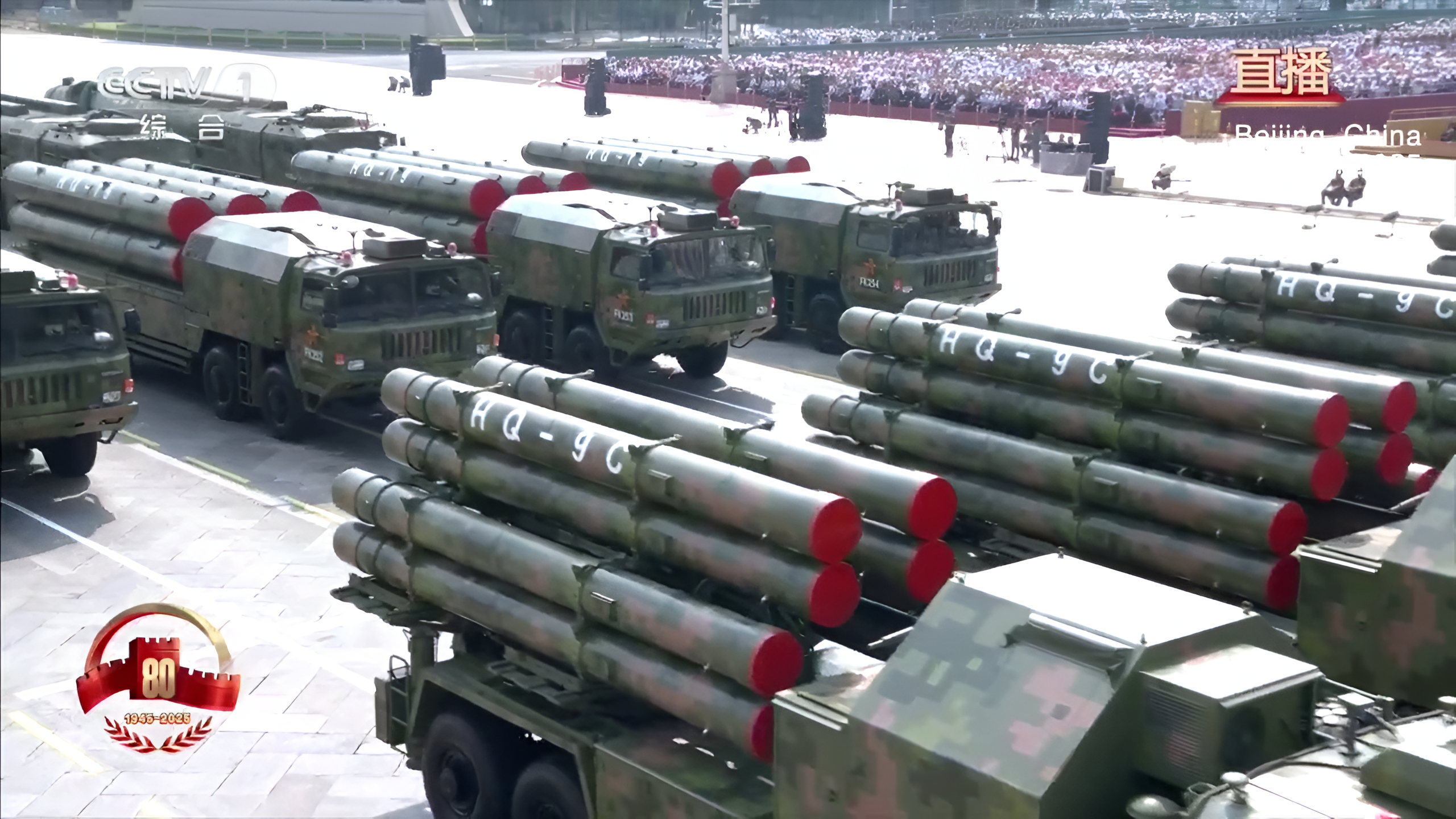
China’s Victory Day Parade 2025 displayed the country’s rapidly expanding air defense arsenal comprising of upgraded variants as well as entirely new Surface to Air Missile (SAM) systems. China’s air defense system – consisting of short-range point defenses to long-range strategic interceptors – is rapidly evolving into layered defensive architecture. This parade not only reflected Beijing’s technological advancements in missile defense, but also sent a powerful strategic message about its growing ability to establish multi-layer air defense envelop against variety of aerial threats.
Leading the column of air-defense systems was HQ-11, with each launcher carrying missiles in canisters and a folded radar antenna. HQ-11 has the capacity to work as an independent unit, or it can also work in conjunction with LD-3000 gun-component (not shown in parade) which consists of integrated radar and a Type-1130 close-in-weapon-system (CIWS). This suggests that HQ-11 is primarily meant for low-altitude short range air-defense against aircrafts, drones, missiles, and other munitions. Next, HQ-20 was revealed for the first time with each launcher carrying eight missiles. Considering the size of its missile, it is safe to assume that it is a medium range missile designed for mid-tier defensive coverage.
After short range and medium range SAMs, various types of long range SAMs with varying capabilities were presented. HQ-22A, consisting of four missiles per launcher, was showcased. In terms of performance, this SAM is essentially a cheap alternative of HQ-9 series of air-defense missiles. As follow on, HQ-9C was revealed for the first time. Compared to existing family of HQ-9A/B, HQ-9C missiles are slimmer. It is likely meant to operate alongside HQ-9A/B in somewhat similar role as U.S. PAC-2 and PAC-3 missiles of Patriot air-defense system.
After HQ-9C, dedicated anti-ballistic missiles (ABMs) made the appearance. HQ-19 ABM, comprising of six long-range missiles per launchers, marked their presence once again. This system is often regarded as China’s equivalent of U.S. THAAD and is believed to be effective against medium and inter-mediate range ballistic missiles. Then, HQ-29 made its highly anticipated public debut. Comprising of two large air-defense missiles per launcher, this system is configured for mid-course interception of inter-continental ballistic missiles (ICBM) or can even be used as anti-satellite weapon (ASAT). In terms of role, it is analogous to U.S. ship-borne SM-3 Block-IIA or Ground-based Mid-course Defense (GMD) missile. Interestingly, unlike U.S. systems, its TEL mounted, and therefore shares similar design characteristics as Russia’s yet-to-operationalize S-500 BMD system.
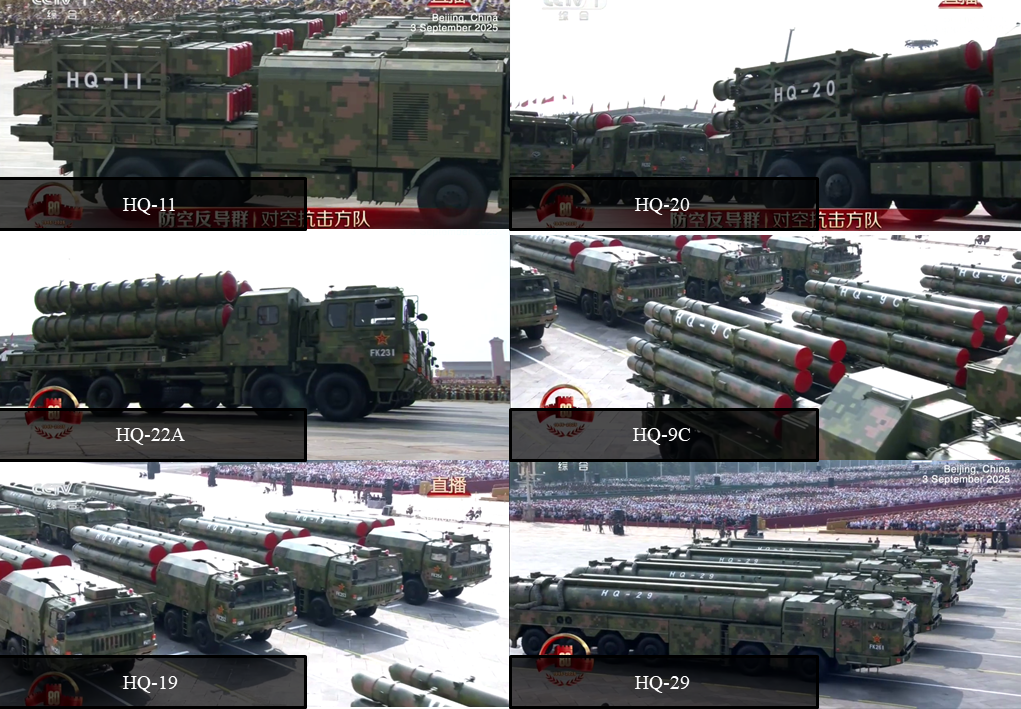
HQ-11, HQ-20, HQ-22A, HQ-9C, HQ-19, and HQ-29 at China’s 80th Victory Day Parade
Following large and high-echelon air-defense systems, several new generation vehicle-mounted tactical and point-air defense systems also made official debut. In the domain of directed energy weapons (DEW), three systems of varying capabilities were presented: OW5-A10 laser system mounted on Mengshi armored vehicle which can intercept drones using 10kW laser; OW5-A50 laser system based on truck and capable of producing 50kW laser against aerial threats; and Hurricane-3000 microwave weapon system (MWS) which are believed to be effective against aerial-drone swarms. Although road-mobile, the system is designed for protecting fixed installation and needed to be powered by an external power source which was not displayed at the parade.
After DEW column, two different types of gun-missile tactical air defense systems were presented. First, PLB-625 mounted on 8×8 wheeled chassis which can engage diverse range of aerial threats using a 25mm Gatling gun as well as four FN-16 manpads. Second, FK-3000 anti-aerial drone system based on 6×6 truck platform and equipped with 96 micro-missiles and a 30mm chain gun. Both PLB-625 and FK-3000 feature integrated radar and electro-optical system for detection and engagement of air threats of low radar and IR signature.
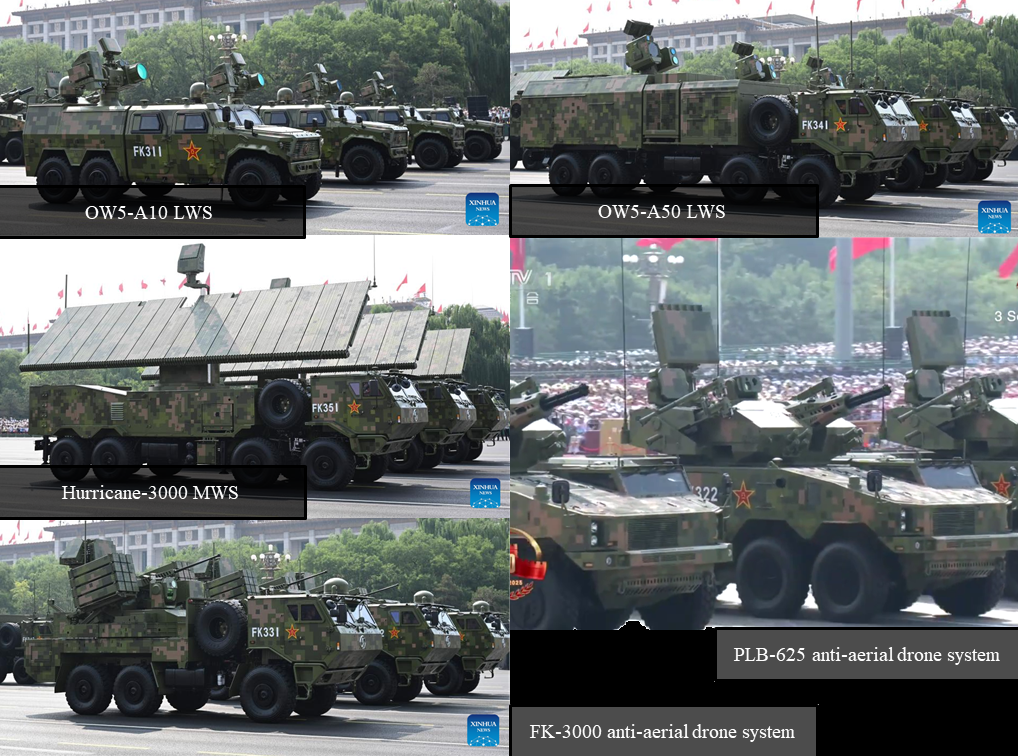
OW5-A10 LWS, OW5-A50 LWS, Hurricane-3000 MWS, PLB-625, and FK-3000 anti-aerial drone systems at China’s 80th Victory Day Parade
The pattern of development in China’s air defense systems is interesting as it incorporates U.S. style as well as Russian style capabilities. The air defense philosophies of the U.S. and Russia are vastly different from each other. U.S. has historically maintained significant advantage in airpower, subsequently undermining low-mid spectrum of aerial threats. Therefore, U.S. has channelized its efforts to develop air defense systems for countering high-end threats like cruise and ballistic missiles. Systems like Ground-Based Midcourse Defense (GMD), THAAD, and Standard Missile-3IIA (SM-3IIA) are optimized for long-range and exo-atmospheric interceptions. Patriot defense system provides anti-aircraft and anti-missile defensive cover using PAC-II and PAC-III missiles respectively at medium ranges. However, the U.S. has relatively limited investment in tactical point defenses, with NASAM being the most popular example. Russia, by contrast, doesn’t enjoy decisive edge in airpower and therefore has maintained defensive posture by developing a comprehensive, redundant, and mobile shield to safeguard its vast territory against a broad spectrum of threats. Systems like the Pantsir-S1, Tor-M2, and Buk provide short-medium range protection, while the S-300, S-350, and S-400 SAMs cover long-range and strategic threats, including ballistic missiles. Russian systems are road-mobile and heavily layered, prioritizing redundancy and resilience against saturation attacks, and have rather limited anti-ballistic capability particularly when compared with U.S. counterpart.
China’s 2025 Victory Day parade demonstrated how Beijing has fused both approaches into a hybrid and uniquely Chinese architecture. Systems like HQ-11, HQ-20, HQ-22A, and HQ-9 variants mirror Russia’s tiered, overlapping structure, while the HQ-19 and HQ-29 resemble U.S.-style specialized interceptors for ballistic missile and even anti-satellite missions. The introduction of directed energy weapons (OW5-A10, OW5-A50) and microwave-based systems, alongside anti-drone platforms such as the FK-3000 and PLB-625, highlights China’s growing emphasis on countering emerging drone swarms—an area where it is arguably more advanced than both Washington and Moscow. In effect, as showcased by 2025 Victory Day parade, China has synthesized U.S. technological sophistication with Russian-style redundancy and mobility, while adding its own innovations. The result is a layered defensive shield capable of countering threats ranging from drones to ICBMs, reflecting Beijing’s ambition to field one of the world most diversified and future-oriented air defense systems.