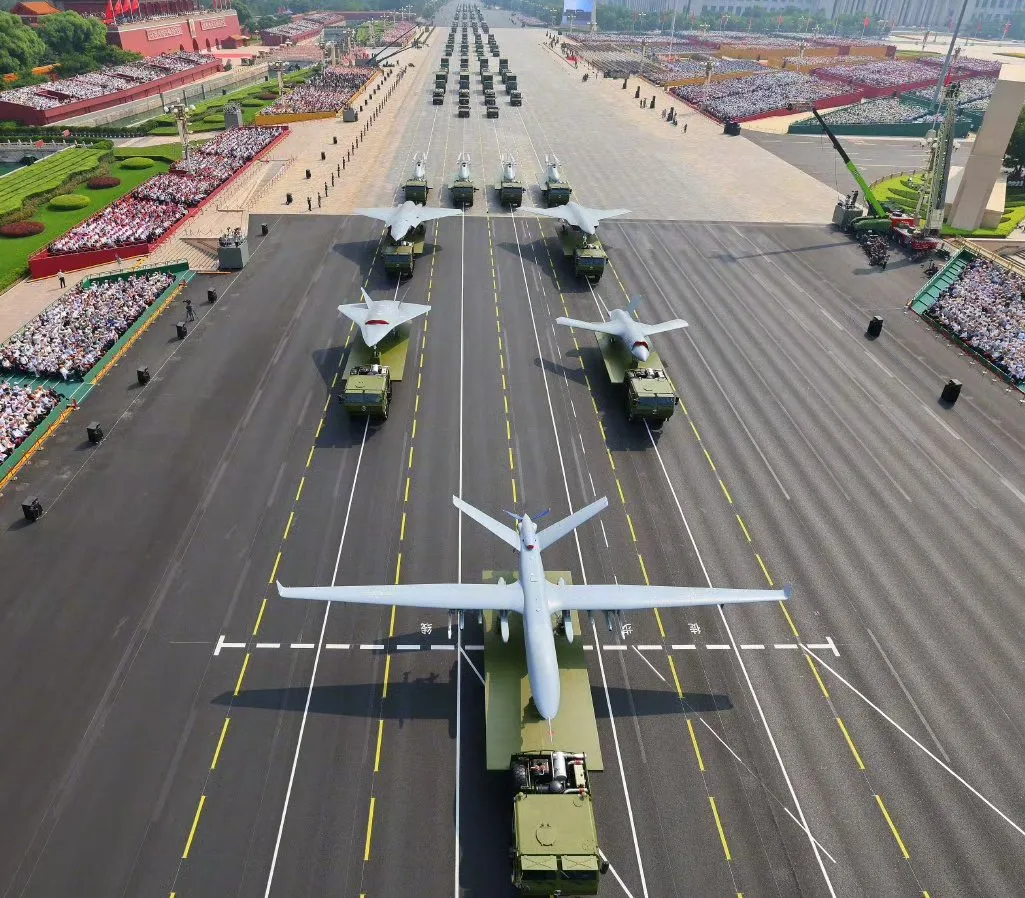
The 80th Victory Day Parade in Beijing provided a rare glimpse into the future of China’s airpower by unveiling next generation manned and unmanned aircrafts. The parade showcased impressive formations of 5th generation stealth fighter aircrafts, advance 4th generation jets, special mission aerial platforms, transport planes, and a diverse range of futuristic unmanned aerial systems (UAS). The air-components of People’s Liberation Army Air Force (PLAAF) and People’s Liberation Army Navy (PLAN) were presented into two categories. First, stealth unmanned aerial systems mounted on trucks; and second the air-formations of manned aircrafts at the end of parade.
Several types of advance aerial drones of varying size and shape were revealed for the first time. The centerpiece of the display was the unveiling of two heavy jet-powered unmanned air dominance fighters, informally referred to by observers as Type-A and Type-B. Roughly comparable in size to China’s J-10 fighter aircrafts; these designs represent a generational leap beyond earlier combat drones. Both aircraft featured tailless configurations, large internal weapon bays, and aerodynamic profiles optimized for stealth, supersonic speeds, and high maneuverability. Type A incorporates a lambda-shaped wing, while Type B features a diamond-shaped wing design. Details such as diverter-less supersonic intakes (DSI) and serrated engine nozzles for radar cross-section reduction, reflect design philosophies seen in fifth- and sixth-generation fighters. These features suggest not only the potential for supersonic flight but also the possibility of supercruise capability, all while maintaining stealth characteristics. Operationally, these drones could be employed both as independent fighters and as collaborative combat aircraft (CCAs) also dubbed as loyal-wingman, extending the situational awareness and strike reach of manned formations. Without human pilots, their maneuverability could exceed the traditional 9G limits of manned aircraft, giving them a decisive advantage in missile evasion and close-in dogfights. Internal weapon bays appear capable of carrying air-to-air missiles, which can be mix of within-visual range (WVR) and beyond visual range (BVR) missiles, suggesting their role as true air dominance platforms.
Alongside these heavy drones, China also displayed a pair of medium jet powered UCAVs—informally named Type-C and Type-D. These drones, roughly the size of a JL-10 trainer, embody a mid-to-low tier capability set. Type-C, resembling the FH-97 UAV, appears optimized for range and payload, likely serving as a “munitions expander” for strike missions or cruise missile defense in moderately contested airspaces. Type-D design emphasized speed and stealth, incorporating swept wings, flat fuselage profiles, and stealthy exhaust nozzles. Their roles would include acting as sensor extenders, electronic warfare platforms, or communication relay nodes in formation with fifth- and sixth-generation fighters. It appears that just like Type-A and Type-B, Type-C and Type-D also has the capability to operate independently as well as CCA.
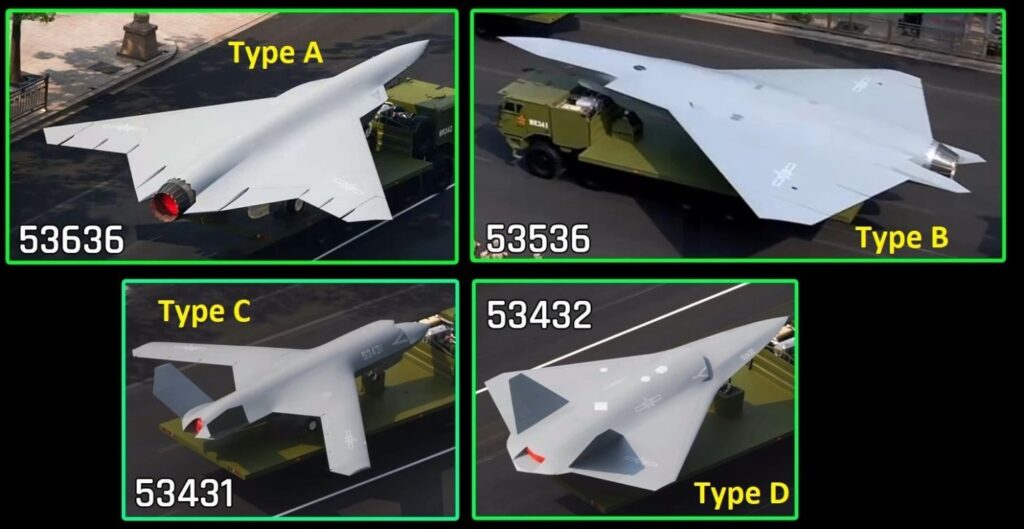
Next Generation jet-powered stealth UCAVs at China’s 80th Victory Day Parade
Beside entirely new drones, the parade once again showcased GJ-11 Sharp Sword and Wing Loong-II MALE UCAV which have been revealed in earlier parades. At the end of column of unmanned systems, drone helicopters with foldable main rotor, electro-optical pod, side mounted sensory arrays, and maritime surveillance radar was revealed. This un-named rotorcraft appears to be purpose built for naval operations and can be carried easily by all types of PLAN warship with flight deck facility. The incorporation of this drone helicopter will significantly enhance fleet’s operational flexibility by ensuring persistent maritime domain awareness (MDA) through over-the-horizon (OTH) intelligence surveillance and reconnaissance (ISR) at minimum operating cost.
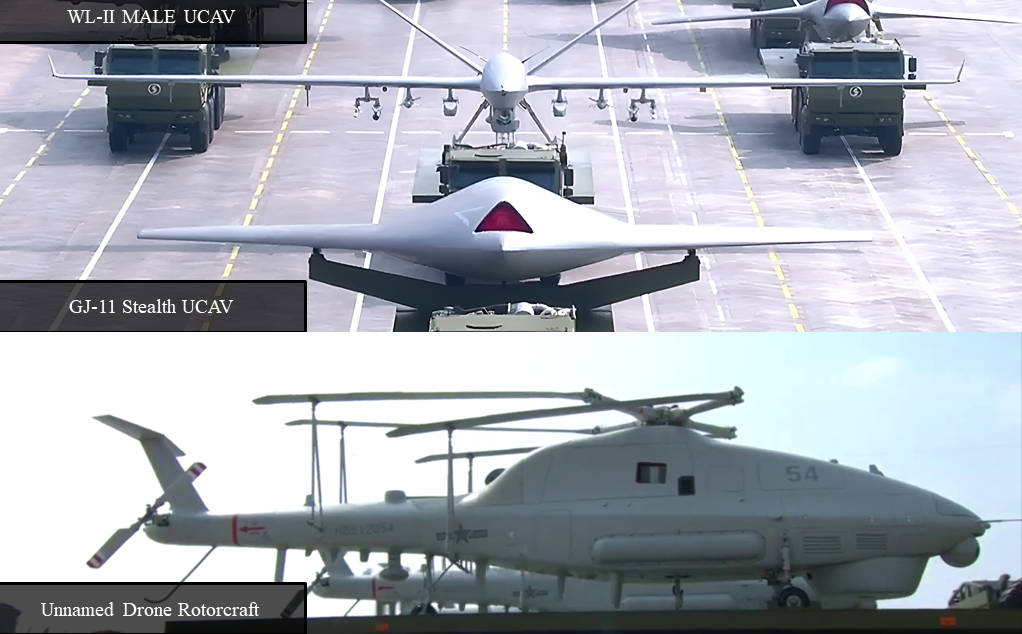
GJ-11, Wing Loong-II and unnamed drone rotorcraft at China’s 80th Victory Day Parade
The formations of manned aircrafts appeared at the terminal phase of Victory Day Parade. KJ-500A Airborne Early Warning & Control System (AEWCS) of PLAAF led the air parade. With inflight refueling and 360 degree AESA radar coverage, the KJ-500 provides extended early-warning coverage and supports joint targeting for fighters and missile forces.KJ-500A was escorted by multi-role J-16 Flanker-N which is currently the most advance flanker variant in world. The highly anticipated KJ-600 carrier-based AEWCS, China’s analogue to U.S. E-2D Hawkeye AEWCS, led the PLAN aviation formation. The incorporation of this fixed-wing AEWCS will significantly enhance the situation awareness and combat prowess of PLAN carrier aviation. KJ-600 was escorted by two pairs of J-15T Flying Shark. J-15T is currently the most capable carrier borne flanker in the world and has been optimized to conduct catapult launch from Fujian aircraft carrier.
Following PLAN formation, H-6K, H-6J, and H-6N flew over the parade arena. H-6 is based on old Soviet Tu-16 bomber, but has been overhauled and modernized to meet modern standards. H-6K is primary cruise missile and tactical ballistic missile carrier of PLAAF. H-6J is configured to carry anti-ship missiles of various types. H-6N is part of China’s air-leg of nuclear triad and is integrated with nuclear armed ballistic missile like JL-1 ALBM.
A dedicated formation of Electronic Warfare (EW), comprising of Y-9LG Electronic Intelligence (ELINT) aircraft and a pair of J-16D EW aircrafts, was also showcased. J-16D carries jamming pods on external stations and is the China’s equivalent to U.S. F/A-18G Growler EW aircraft. Specialized aircrafts like KQ-200 Maritime Patrol Aircraft (MPA) escorted by a pair of J-15T, and Y-20A/B strategic lifter also made notable appearance in air. The inflight refueling capability of YY-20 aerial tanker was demonstrated by conducting probe-and-drogue refueling of pairs of H-6N, J-16D, and J-20 aircrafts.
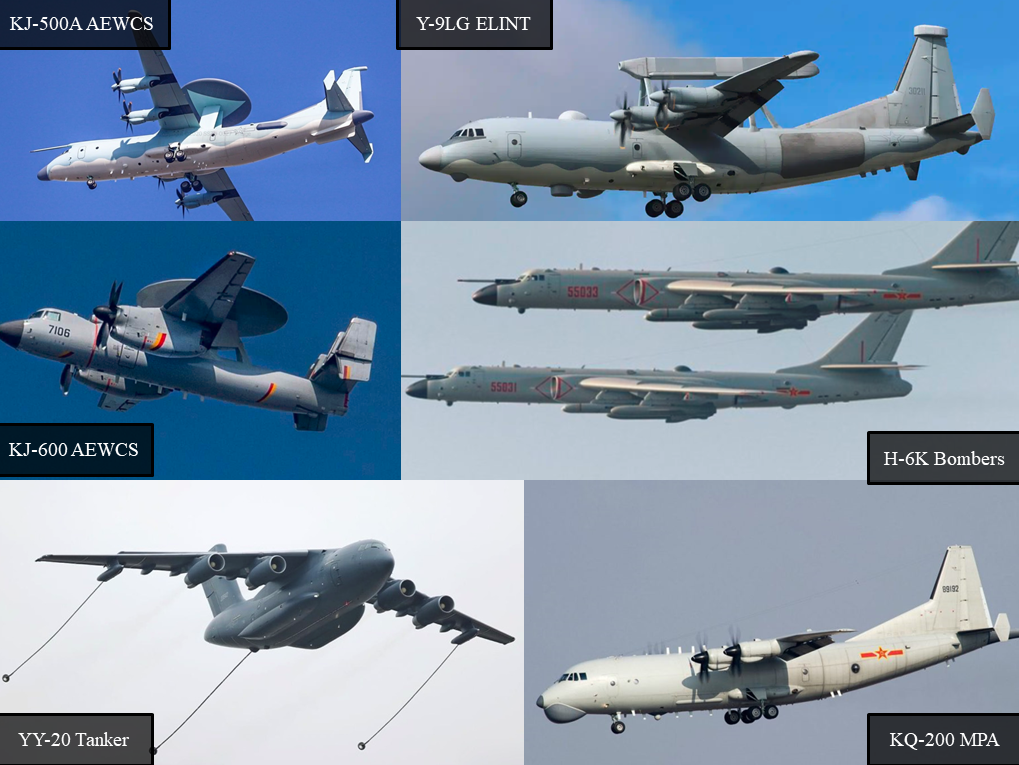
KJ-500A, Y-9LG, KJ-600, H-6K, YY-20, and KQ-200 (file photo)
Perhaps the most eye catching moment of air parade was formations of China’s stealth fighter aircrafts. J-20 Mighty Dragon is the cutting edge of PLAAF air-superiority prowess and so far 300 units have been inducted. Beside the base model, newer J-20A with twin-seat J-20S versions were also revealed. Currently, J-20S is the only twin-seat stealth fighter in world. It is speculated that J-20S has been specialized for manned-unmanned teaming operations. J-35 Gyr Falcon, the medium category stealth fighter, did the public debut by flying in arrowhead formation. This twin-engine aircraft has land based version for PLAAF called J-35A, and a carrier based version for PLAN termed as J-35. The operationalization of two different types of stealth fighter aircrafts has essentially made China the second nation after U.S. with F-22 Raptor and F-35 Lightening-II projects.
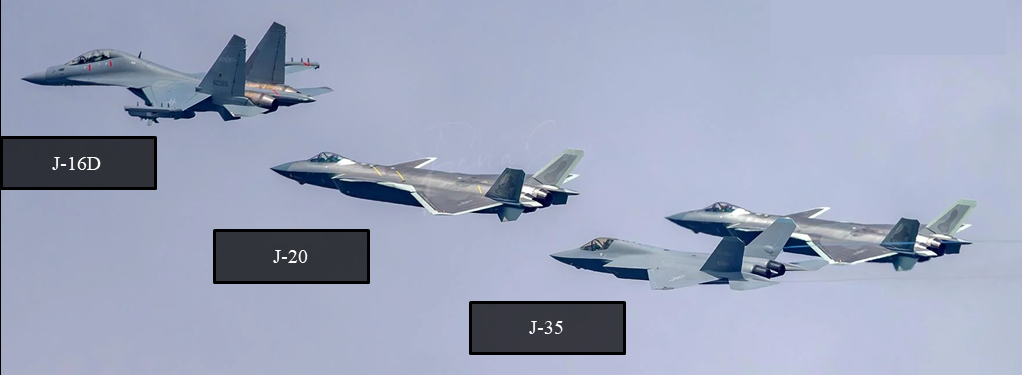
J-16D, J-20, and J-35 in formation (file photo)
In the end, arrowhead formations of advance 4th generation aircrafts were presented. Five J-15s, five J-16s, five JL-10 supersonic advanced jet trainers, and five J-10C Vigorous Dragon aircrafts flew over the parade arena. The parade culminated with formation flight of PLAAF Ba Yi acrobatic team’s seven J-10s – painted in blue, red, and white colors and carrying wing-mounted red-smoke pods.
Strategically, the parade served as more than a display of hardware as it signaled China’s technical competence and its intent to operationalize these systems in the near future. Unlike Russia, which also periodically showcases new military hardware in parade, China has the economic, technological, and industrial potential to mature and mass produces these systems. The recent May-2025 crisis served as the litmus test of effectiveness of China’s aerial platform when a rather “mid-level” J-10CE fighter aircrafts of Pakistan Air Force (PAF) successfully shot down six combat jet of Indian Air Force (IAF) including three highly celebrated Rafale-F3Rs. This suggests that China’s military prowess is no longer a theoretical proposition. Rather it is as practical and credible as that of nations with leading military complex developed through vast combat experience. The showcasing of next generation manned and unmanned aircrafts is a clear indication that China is no longer perusing ideas crafted by other nations, rather China is committed to shape the future of air combat by transitioning from manned-centric air combat to a tiered collaborative manned-unmanned era of air combat.