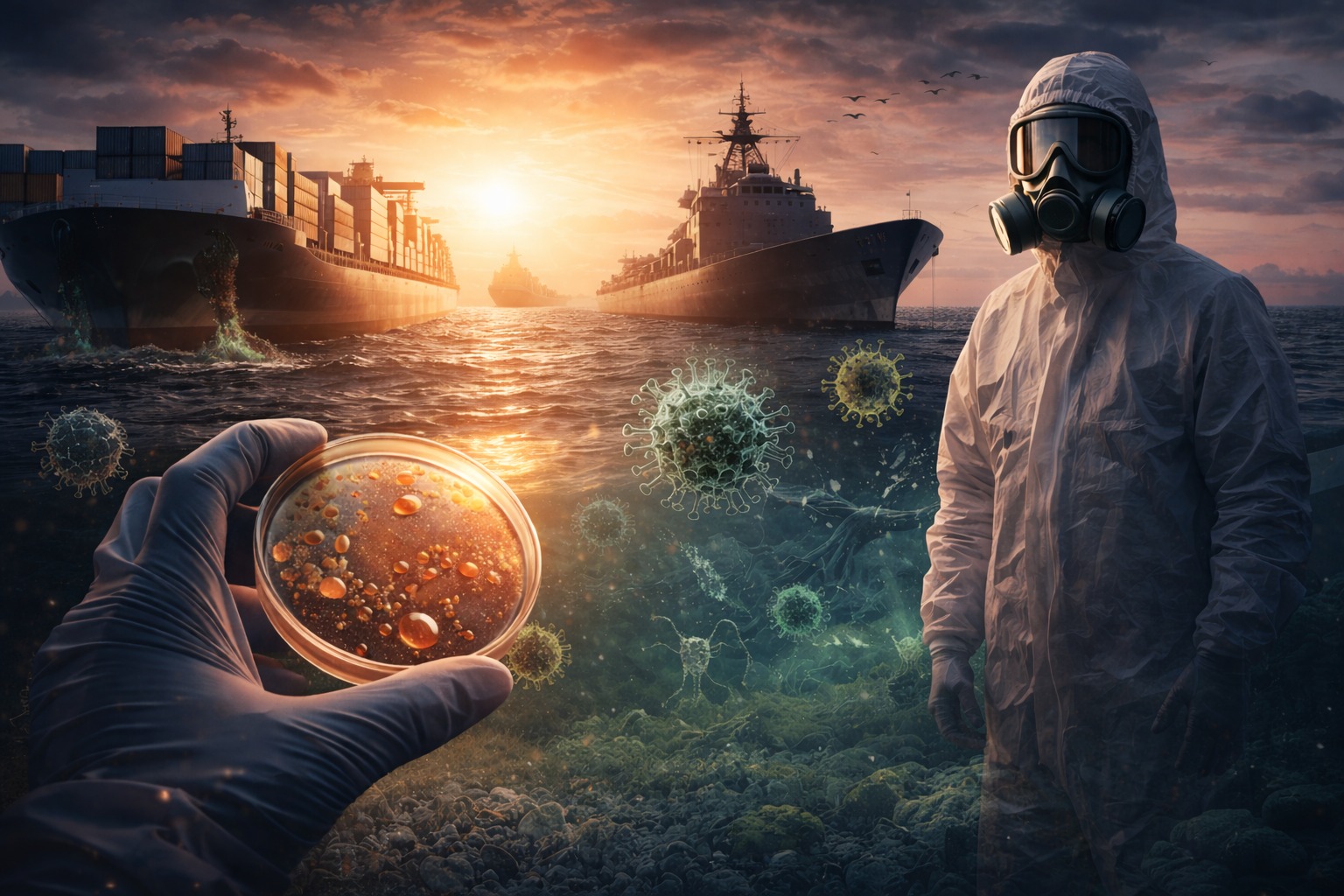
In a hybrid threat, an agent can be as devastating as a missile, particularly when it comes into play via a large seaport. The sea is no longer only a means of trade or a place of naval struggle, but is quickly becoming a biosecurity battlefield. It has been estimated by the International Maritime Organization that more than 70 percent of world commerce by weight and greater than 80 percent by worth is conveyed by sea, so ports are considered vital to economic existence but perilous to biological encroachment (IMO, 2023). These maritime ports of entry are productive trade routes- but are also porous entry points through which biological threats, both unintentional and intentional, may silently enter countries.
A Silent Yet Deadly At Sea Threat
Biological warfare is by no means a recent development, but combining it with maritime infrastructure creates a dangerous element of complexity. Ports act as transit hubs of the world: pathogens can be present in ballast water, contaminated cargo, or sick workers. The cause behind the 1991 cholera outbreak in Peru, in which Vibrio cholerae that had been released through ballast water of an Asian cargo ship resulted in the deaths of over 10,000 individuals in Latin America, showed how maritime trade can inadvertently spur on biological calamities (McCarthy & Khambaty, 1994).
History is even more renouncing. In 1347, corpses with the plague were thrown into the port of Caffa, and Genoese ships that were fleeing to the continent brought the Black Death to Europe. That episode is one of the earliest in the history of individual acts of maritime bio-sabotage. With the high level of global interconnection, the effects of a comparable failure in modern times would be multi-fold higher.
The Strategic Maritime Exposure of Pakistan
The 1000-kilometre-long Arabian Sea coastline of Pakistan has two ports: Karachi, where most of the national freight is processed, and Gwadar, a future trans-regional hub under the China-Pakistan Economic Corridor (CPEC). Although they were important, neither of the ports has a full maritime biosecurity architecture that incorporates disease surveillance, port sanitation, customs bio-screening, and coordinated maritime health response.
Ports are a critical entry point in the management of the public-health emergency, according to the International Health Regulations (2005) by the World Health Organization, which encourages One Health approaches that relate human, animal, and environmental health (WHO, 2021). The models have been used in many modern maritime economies, while Pakistan has not.
The Growing Biothreats Spectrum of Maritime
With an ever-militarized Indian Ocean, especially with India, China, and extra-regional sea power naval forces, the threat environment has ceased to exist in the context of missiles or cyberattacks. It now includes:
- Noiseless biological invasions of port ecosystems.
- Bio-sabotage of ship water-systems, food or ventilation.
- Attacks that are Low-attribution in nature to avoid quick detection.
The North Atlantic Treaty Organization has also recognized maritime biothreats as non-conventional threats that can generate strategic impacts that are out of proportion to their cost and traceability (NATO Review, 2011). On the same note, the United Nations Office on Drugs and Crime has identified the maritime sector as an under-regulated pathway of biological risks and transnational crime (UNODC, 2020).
In the case of Pakistan, there is a three-fold risk:
- Emergencies in human health in the thick megacities of Karachi, along the coast.
- Destruction of the marine ecosystem, which poses a threat to livelihoods based on seafood.
- Freezing of the economy due to port quarantine or a long shutdown.
The Missing Security Layer
The port security regime in Pakistan is different as it is still too preoccupied with customs controls and contraband interdiction to the point that biosecurity has been overlooked. There is no CBRN (Chemical, Biological, Radiological, and Nuclear) monitoring coordinated at the maritime ports of entry, as there are quarantine stations and health screenings at airports and land crossings.
An acceptable answer requires an institutional assimilation. The Pakistan Navy, the National Institute of Health, and the Ministry of Maritime Affairs should collaborate:
- Create bio screening areas at large ports.
- Connect the Navy preparedness to the civil-preparedness (public-health) response units.
- Install mobile laboratories and biosurveillance wastewater.
Integration of biothreat scenarios into crisis and war-gaming in the Navy.
An International Risk, A National Burden
The speed of biological threats is greater than the speed of inspection regimes. The COVID-19 crisis revealed the vulnerability of the maritime system as more than 400,000 seafarers were trapped all over the globe, disruptions to the world supply chains, and colossal losses to the economy (International Chamber of Shipping, 2020). The following interruption is not necessarily accidental. It could be engineered.
It is no alarmism to be mindful of this danger, but a good statecraft.
Securing the Blue Frontier
It is no longer a maritime border of trade or naval force, but a biosecurity border. The National Security Policy of Pakistan should be clear about this fact. Preparedness to bio-preparedness is not only a public-health issue, but it is also a strategic sovereignty matter.
Through the creation of a Maritime Biosecurity Task Force and investing in CBRN preparedness, integrating biosurveillance into the CPEC system, and achieving maritime resilience, Pakistan can be a leader in the region regarding the resilience framework. Only then will its blue waters be a source of prosperity, not of plague.